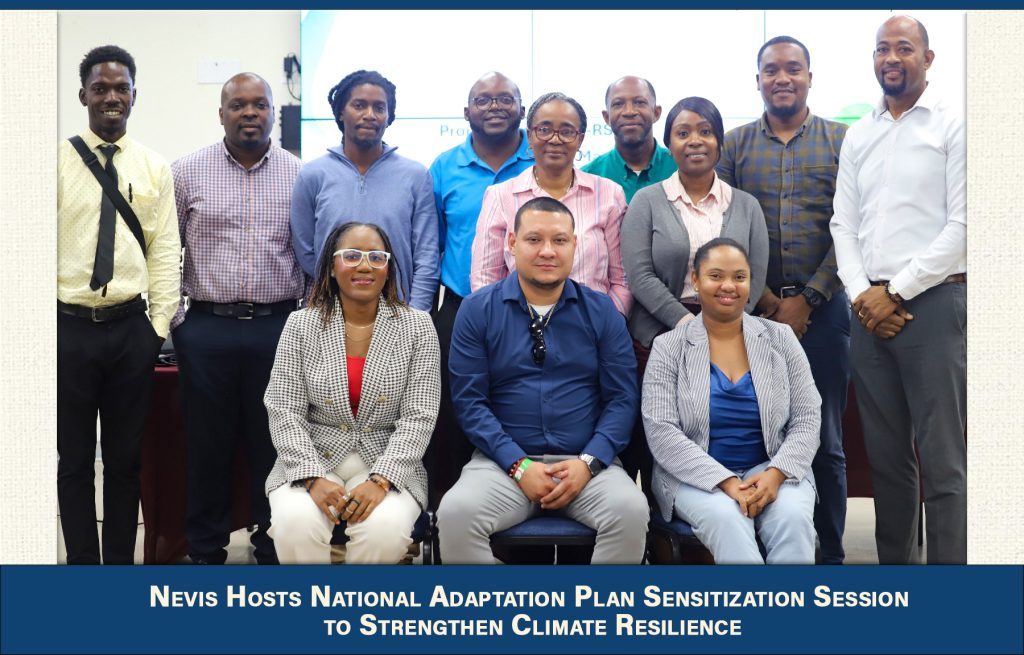
Nevis, Saint Kitts and Nevis, 5th of February, 2026 — Government officials, technical agencies, and key sector representatives gathered in Nevis for a National Adaptation Plan (NAP) Sensitization Session to advance climate adaptation and strengthen national resilience. This session supports the country’s commitment under the United Nations Framework Convention on Climate Change to address climate risks through structured long-term planning.
The workshop included representatives from planning, public health, environment, infrastructure, and other key sectors. Discussions highlighted that climate change impacts are immediate challenges for water supply, agriculture, ecosystems, and livelihoods.
A statement from a local farmer captured the urgency of the situation: “The rain is just not coming as it used to.”
This observation highlights the growing frequency of prolonged dry periods and droughts, which pressure small island systems.
Purpose of the Session
The sensitization session sought to:
- Build a common understanding of climate change adaptation
- Introduce the National Adaptation Plan (NAP) process
- Highlight the importance of adaptation for small island developing states (SIDS)
- Prepare stakeholders for ongoing engagement in the NAP development process
- Emphasize coordination across sectors
Speakers emphasized that climate change involves not only stronger storms but also longer dry periods, water scarcity, and ongoing environmental stress. Planned adaptation is now essential.
National Adaptation Plan as a Strategic Framework
The NAP was presented as a critical national framework to:
- Strengthen governance and inter-agency coordination
- Support vulnerable sectors, including health, agriculture, tourism, and infrastructure
- Enhance climate data and information systems
- Mobilize adaptation finance
- Engage the private sector in resilience-building
Adaptation refers to adjustments in ecological, social, or economic systems in response to actual or expected climate impacts to reduce harm and build resilience. This includes policy reform, infrastructure improvements, behavioral change, and ecosystem management.
Stakeholder Contributions
During an interactive segment, participants shared personal and institutional adaptation measures already in place. Examples included rainwater harvesting, backyard farming, drought-resistant crops, solar lighting, recycling, reduced energy use, and stricter building requirements for water storage in new developments. These actions show community efforts align with national adaptation priorities.
Global Context and Local Relevance
The session referenced the Paris Agreement, which calls for stronger adaptation efforts under Article 7. Presenters noted that investing in adaptation provides significant economic and social benefits, while inaction increases long-term risks and recovery costs.
Participants emphasized several cross-cutting priorities:
- Improved coordination to reduce silo operations
- Inclusion of youth, elderly persons, vulnerable groups, and the private sector
- Strengthening national climate data systems
- Integrating adaptation into national budgets, sector plans, and development strategies
Why the NAP Matters
For Saint Kitts and Nevis, the NAP:
- Moves adaptation from isolated projects to long-term governance
- Supports access to international climate finance
- Aligns with sustainable development and disaster risk reduction goals
- Enhances resilience across sectors
Officials emphasized that the NAP is a national framework guiding coordinated climate resilience, not just a document.
Next Steps
The NAP process will continue with stakeholder consultations, stocktaking and gap analyses, development of sectoral adaptation priorities, and drafting and validation of the plan. Stakeholders will remain involved throughout.
Conclusion
The session raised awareness of climate impacts, clarified the importance of adaptation, and demonstrated stakeholder commitment to coordinated, inclusive, and long-term resilience planning. The workshop marks a key milestone in the federation’s progress toward climate-resilient development.